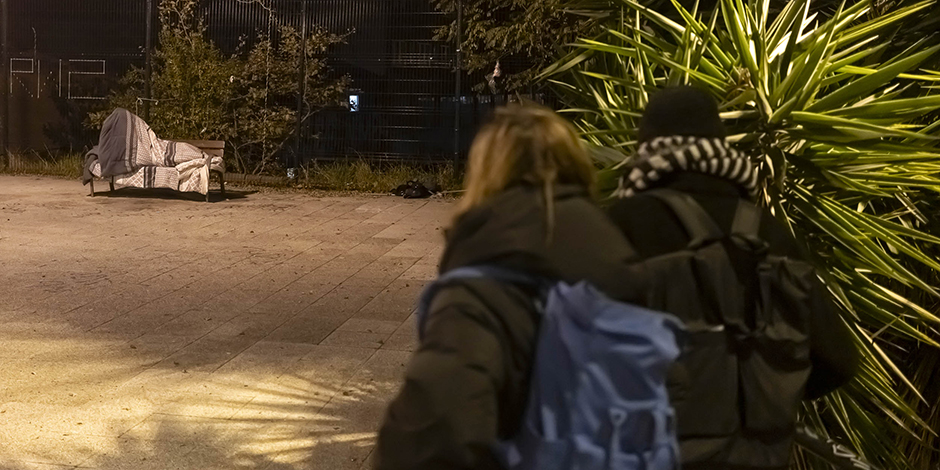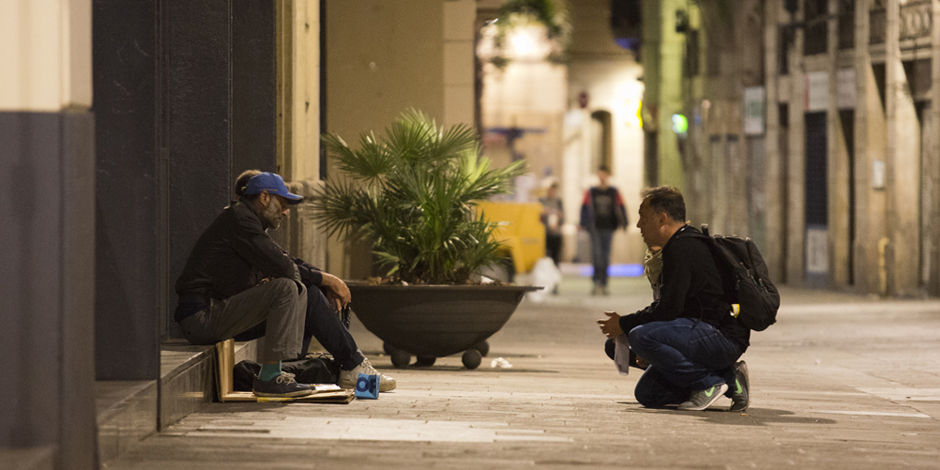

When she was 17 years old, she met her husband, and father of her children, and begun to take drugs with him. As time went by, the situation deteriorated to the point that Angie, pregnant and alone, lived in the streets of Barcelona for a whole week.
“ That happened when I was taking drugs. I stayed only a week, but it branded me for life, for not to come back never again”, she explains. “When you are living in the streets you don't know where you are going to, where you are going to sleep, not knowing what will happen to you, and that is very hard”.
She left the streets thanks to the support of a radio station. From that point, she went back to her husband, to her home in Figueres, until she split up with him and decided to start again as a businesswoman. It was then when she was diagnosed with cirrhosis, and she had to undergo a liver transplant, having two rejections. “ I have been about to die twice, I had thrown in the towel, I was fed up”,she relates. From the hospital she was referred to “Llar de Pau, where she stayed for two years, recovering physically and emotionally.
At present, Angie is living on her own. “I have rented a room shared with another woman and her daughters. The truth is that I am very well. I am still going to “Llar de Pau”s workshops, having lunch and supper there because, out of the 439 Euros I earn monthly, I spend 300 in the flat and only have 139 for the month”, states Angie.
Despite her problems, Angie only looks ahead: sends C.V. to work as a security guard and waits for her boyfriend coming back to Barcelona to start a new life together. In the meantime, she is linked to “Llar de Pau” in order to be an example for another women of the centre. “I try to help them, from my own experience, as much as I can. I'm not someone special, I am like them; if I have been able to get out of it, others also can. It is hard, but one have to want to do it”.
Angie Time in the streets: one week Now: she is living in a rented room
In March 2000 the Heads of State and Government pledged themselves to "making a decisive impact on the eradication of poverty" by the year 2010. Despite the efforts deployed, a significant proportion of the European population still lives in destitution and has no access to basic services such as health care. 2010 represents an opportunity to make policy changes that will have a real impact on combating inequalities and create a Europe free of poverty and social exclusion. NGOs therefore call for mobilisation at local, national, and European level.
Having a good time watching a football match with flatmates or being in your room quietly watching a film, without feeling alone. The 17 flats Arrels administers have television because it fulfils a social function. As the analogue to digital switch-over is about to arrive, we need DDT to keep on putting a roof.
One of our founders tells a story that takes place one day while passing out sandwiches to people waiting on line. Suddenly someone turned around and, after taking the sandwich, threw it back. This sandwich, as it flew through the air, became the spark that ignited a process of understanding that perhaps sandwiches were not what people needed most. This was the seed, the first inkling that what people were looking for and what they needed, perhaps without knowing it, was something more.
The International Prize Alfons Comín recognized in 2009 the work of Arrels foundation, that accompany, in Barcelona, the homeless in a serious situation of exclusion and denounces their reality. The prize puts on the table the difficulties of the inclusion and the right of housing.